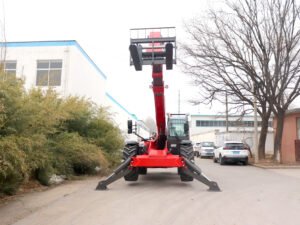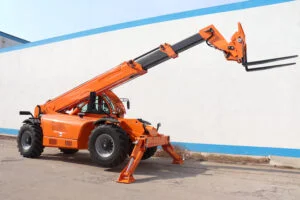
Choosing the wrong telehandler is a costly mistake. It wastes time, blows budgets, and compromises safety. An oversized machine can’t fit, while an undersized one can’t do the job.
To choose the right telehandler size, you must balance three key factors: the maximum weight you need to lift, the height and reach required, and the physical constraints of your job site. Always consult the machine’s specific load chart to confirm its capabilities for your exact task.
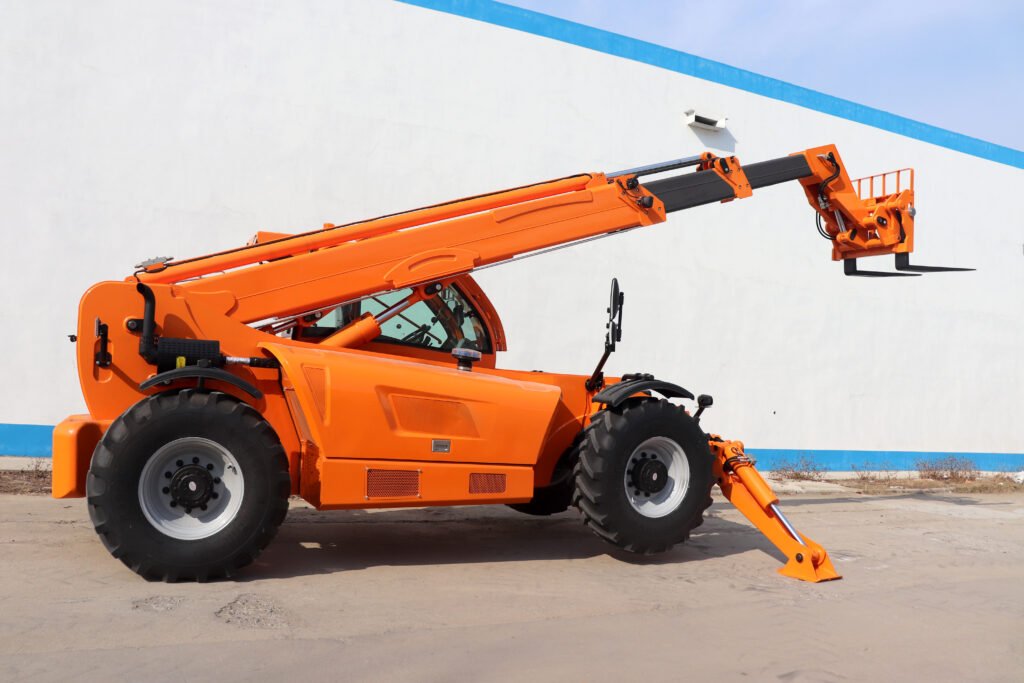
Over my 15 years of exporting telehandlers from our factory in Shandong, China, I’ve seen this question come up thousands of time. A customer in Germany might need a compact machine for tight farmyards, while a client in Australia needs a large one for a sprawling construction site. The answer is never just a single number. It’s about a process. Let’s walk through that process together so you can choose a machine that feels like it was custom-made for your work.
How Do You Choose the Right Telehandler for Your Needs?
You’re facing a big investment, and the pressure is on to get it right. Pick wrong, and you’re stuck with a machine that’s either too big for your space or too small for your loads.
The best way to choose is by using a two-step method. First, analyze your tasks to define your lifting needs. Second, analyze your job site to understand your physical limitations. This combined approach ensures you get the perfect balance of power and agility.
I guide my clients through this decision every day. The most common mistake I see is focusing only on the maximum lift capacity. A client might say, “I need a 4-ton telehandler.” My first question is always, “At what height and reach?” The secret to a smart purchase lies in the details. I’ve developed a simple philosophy I call the “95% Rule” that helps bring clarity.
The 95% Rule: Your Guiding Principle
Think about all the tasks you do in a typical month. The “95% Rule” states that you should choose a machine that can handle 95% of those tasks perfectly. What about the other 5%? Those are the rare, extreme jobs, like lifting one unusually heavy object or reaching a single, very awkward spot.
It’s tempting to buy a massive machine just for those 5% of jobs. But that means for the other 95% of the time, you’re paying for a machine that’s:
- More expensive to buy and run.
- Harder to transport.
- Less maneuverable in everyday situations.
For that rare 5% of tasks, it is almost always cheaper and more efficient to rent a larger machine for a day or find an alternative solution. By focusing on the 95%, you get a telehandler that is efficient, cost-effective, and perfectly suited for your daily grind. This is the foundation of our selection process. With this rule in mind, we can start looking at your specific environment.
What Are the Possible Applications for Different Telehandler Sizes?
You know a telehandler is versatile, but how does its size affect where it can work? A large machine is useless if it can’t even get onto your site or through a doorway.
The size of a telehandler directly dictates its application. Compact models excel indoors and in tight residential areas, while mid-size units are for general construction. Large machines are reserved for heavy industrial projects with wide-open spaces.
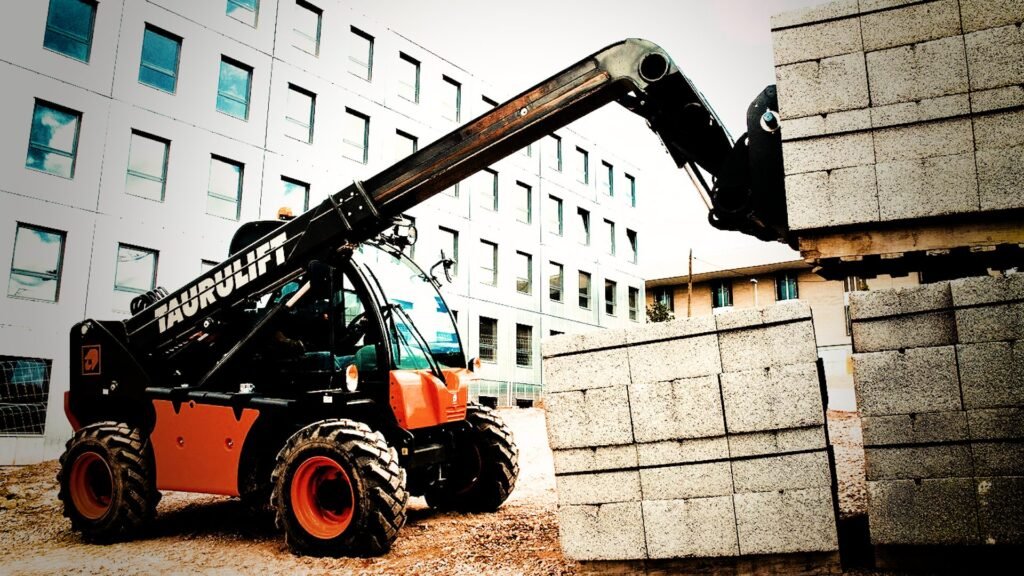
The environment is the first hard limit you must consider. If the machine doesn’t fit, its lifting power is irrelevant. I always tell my customers to measure their site before they even look at a brochure. Let’s break down the common site types and match them with the right class of telehandler. This is how we begin to narrow down your options from the dozens available. From our factory, we produce a range of models, from compact 3-ton units to heavy-duty 6-ton machines, so we have experience matching the right product to every environment.
Matching Machine Size to Your Work Environment
Your job site has non-negotiable limits. Think of gates, doorways, narrow paths, and ceiling heights. Let’s look at four typical environments and see which telehandler size fits best.
| Site Type | Typical Size Requirements | Common Applications & Logic | Our Recommended Models |
|---|---|---|---|
| Indoor & Warehouse | Lift Height: <7m Capacity: <3 tons Width: <2m | Logic: Must fit through standard industrial doors and navigate tight aisles. Low emissions (electric) or good ventilation is key. Turning radius is critical. | Our compact 3-ton models are perfect for this. |
| Residential & Small Sites | Lift Height: 7-10m Capacity: 3-4 tons Width: <2.5m | Logic: Needs to be road-legal for easy transport between jobs. Must be nimble enough for cluttered yards and driveways. Great for lifting roof trusses, bricks, and landscaping materials. | Our best-selling 3-ton and 4-ton telehandlers with a 7m or 10m boom fit this category. |
| Commercial & Mid-Sized Sites | Lift Height: 10-14m Capacity: 4-5 tons Width: ~2.5m | Logic: A balance of reach and power for multi-story buildings. It can handle heavier materials like steel beams or precast concrete sections. Site access is usually better, but maneuverability is still important. | Our 4-ton and 5-ton models with 10m to 14m reach are the workhorses here. |
| Heavy Industrial & Infrastructure | Lift Height: 14m+ Capacity: 5-6 tons+ Width: >2.5m | Logic: Power and reach are the top priorities. These machines work in open spaces like ports, mines, or large-scale infrastructure projects. They often require special transport and use outriggers for stability. | Our 6-ton models with up to 18m reach are designed for these demanding jobs. |
A customer of mine in Poland runs a business renovating old barns into event spaces. He almost bought a 12-meter telehandler, thinking “bigger is better.” I asked him to measure the oldest barn door on his property. It was only 2.3 meters wide. The larger machine was 2.5 meters wide. He would have had a very expensive machine that couldn’t even get to work. We switched him to our 3-ton, 7-meter model, which fit perfectly and handled 100% of his lifting needs. His story is a perfect example: always check the site access first.
What Do You Need to Know About Telehandler Dimensions and Sizes?
You’ve measured your gate, but what about the turning circle? A machine can fit through a gap but still get stuck if it can’t make the turn inside. The overall dimensions are more than just width.
You must consider the machine’s width for access, height for overhead clearance, length for storage, and turning radius for maneuverability. These four dimensions together determine if a telehandler can actually work effectively on your site.
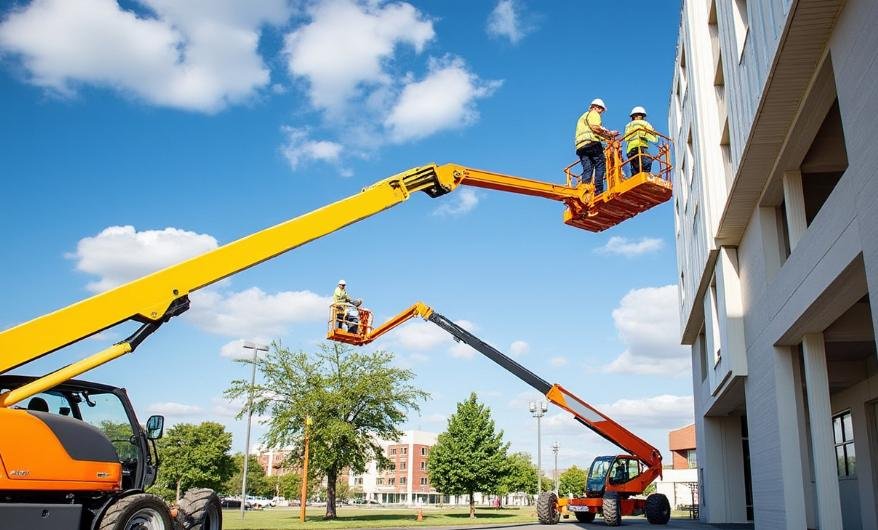
When a customer asks for a “4-ton telehandler,” they are often surprised by the size variation between different models with the same lift capacity. A 4-ton machine built for agriculture might be narrower and longer than a 4-ton machine built for construction, which might be shorter but wider for stability. As a manufacturer with a CE certification for the European market, we pay close attention to dimensions, especially for road transport. A machine wider than 2.55 meters often needs special permits in Europe, which is a major headache for contractors moving between sites.
A Deeper Look at Key Dimensions
Let’s break down these numbers and what they mean for your daily operations. A spec sheet can be confusing, so I’ll simplify it into practical terms.
Tertiary Headings: Dimensions That Matter
- Overall Width: This is the first barrier. Measure your narrowest gates, doors, and pathways. Always leave a safety margin of at least 0.5 meters (about 1.5 feet) for safe passage. Remember that a machine with tires is often its widest point.
- Overall Height (Stowed): Will it fit in your garage or under low bridges on site? Some of our customers need to pass under low-hanging pipes in factories or enter underground parking. Always check the height with the boom fully lowered.
- Turning Radius: This is crucial for agility. A smaller turning radius means the machine can turn around in less space. This is vital in cluttered warehouses or tight construction sites. Most modern telehandlers, including all of ours, feature three steering modes:
- 2-Wheel Steer: Only the front wheels turn. This is best for traveling on the road.
- 4-Wheel Steer: Front and rear wheels turn in opposite directions. This creates the tightest possible turning circle.
- Crab Steer: All four wheels turn in the same direction. This allows the machine to move sideways diagonally, which is perfect for getting closer to a wall or navigating around an obstacle.
- Overall Length: This affects both storage and maneuverability. A longer machine needs more space to turn and is harder to park.
Here is a general guide to what you can expect from different classes of telehandlers. These are typical figures, but you must always check the specific model you’re interested in.
| Machine Class | Typical Width | Typical Height (Stowed) | Typical Turning Radius (Over Tires) |
|---|---|---|---|
| Compact | 1.8m – 2.1m | 1.9m – 2.2m | 3.5m – 4.0m |
| Mid-Size | 2.2m – 2.5m | 2.3m – 2.6m | 3.8m – 4.5m |
| Large | 2.5m – 2.8m+ | 2.5m – 3.0m+ | 4.2m – 5.5m+ |
I remember a client who was setting up a new distribution center. He chose one of our 5-ton models for its lifting power. On paper, it was perfect. But during our pre-delivery consultation, we mapped out the machine’s path inside the warehouse. We realized that while it could fit down the main aisles, it couldn’t make the 90-degree turn at the end without a three-point turn, which would have killed his efficiency. We switched him to a slightly smaller 4-ton model with a superior turning radius. He lost a little bit of max capacity but gained a massive amount of speed in his daily workflow.
Lifting Capacity: How Much Can a Telehandler Really Lift?
You’ve found a machine that fits your site, but can it do the work? You see “4 Ton” written on the side, but this number can be very misleading. It is the most common point of confusion.
A telehandler’s advertised “maximum capacity” only applies when the boom is retracted and at a low angle. As you extend the boom up or out, the actual safe lifting capacity decreases significantly.
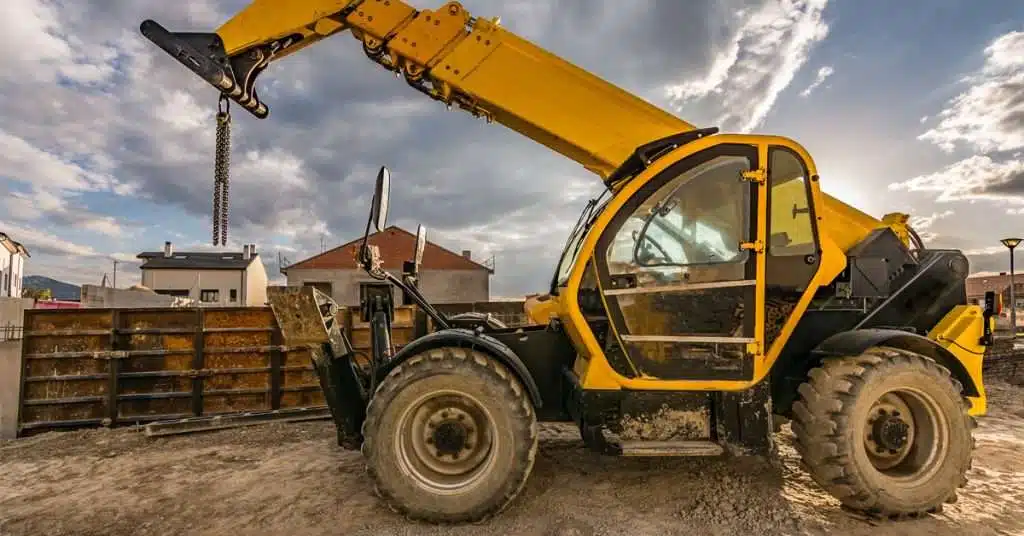
This is the single most important safety concept in operating a telehandler. Ignoring it is how accidents happen. The machine works on the principle of a lever. The further away the load is from the machine’s front wheels (the fulcrum), the less weight it can safely handle before it becomes unstable and risks tipping over. Think of holding a heavy bag of groceries. When you hold it close to your body, it’s easy. When you hold it with your arm stretched out, it feels much heavier and you can’t hold as much. A telehandler is the same.
From Maximum Capacity to Real-World Capacity
So, how do you figure out what your machine can actually lift for your specific job? You need to think in three dimensions: weight, height, and reach.
- Identify Your Heaviest Load: What is the heaviest single item you need to lift regularly? Is it a pallet of cement (around 1.4 tons), a pack of roof trusses, or a bundle of steel? This gives you a baseline weight.
- Determine the Required Height: To what height do you need to lift that load? Are you placing it on a second-story balcony or the roof of a three-story building?
- Measure the Horizontal Reach: This is the step everyone forgets. From where the telehandler will be parked, how far forward does the boom need to reach to place the load? Do you need to clear a ditch, a pile of materials, or a garden bed?
Let’s use one of our popular 4-ton, 10-meter telehandlers as an example.
- Maximum Lift Capacity: It can lift 4,000 kg. But this is only possible when the load is right in front of the machine, maybe 1-2 meters off the ground with the boom mostly retracted.
- Capacity at Maximum Height: If you raise the boom to its full height of 10 meters, the capacity might drop to around 2,500 kg.
- Capacity at Maximum Reach: If you extend the boom forward to its maximum horizontal reach (let’s say 7 meters), the safe lifting capacity could be as low as 800 kg.
As you can see, the 4-ton rating is only a starting point. To truly understand a machine’s capability, you need to look at its most important document: the load chart. This chart translates the physics into a simple, visual guide.
How Do You Read a Telehandler Load Chart Correctly?
The load chart looks complex, like a strange weather map. But ignoring it is like flying a plane without an altitude meter. It is your single most important tool for safe and efficient operation.
A load chart is a diagram inside the cab that shows you exactly how much weight you can safely lift at any given boom height and forward reach. You must use it before every single lift.
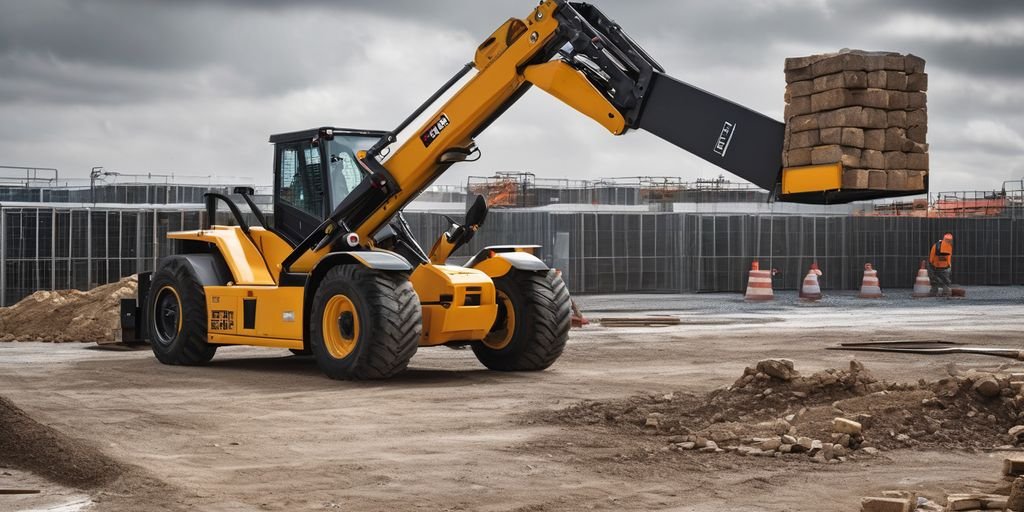
Every telehandler we ship from our factory, whether it’s a 3-ton model or a 6-ton model, has a specific load chart tested and verified for that machine configuration, including its tires and standard fork attachment. It’s not a suggestion; it’s a rule based on the laws of physics. Learning to read it takes only a few minutes, but it’s a skill that will protect your crew, your machine, and your business for years. Let me walk you through it, step-by-step, just as I do during training sessions with new clients.
A Step-by-Step Guide to Your Load Chart
Let’s imagine you need to lift a 1,500 kg pallet of materials to a height of 6 meters, and you have to park the telehandler 4 meters away from the building. Is this lift safe? The load chart has the answer.
1. Understanding the Diagram
A load chart is a graph.
- The vertical axis (Y-axis) represents the lift height in meters or feet.
- The horizontal axis (X-axis) represents the forward reach from the front of the tires, also in meters or feet.
- The curved lines on the chart represent the boom extension and angle.
- The shaded zones or bold lines on the graph show the safe working load in kilograms or pounds.
2. Finding Your Lift Coordinates
First, find your target height on the vertical axis. In our example, that’s 6 meters.
Next, find your required reach on the horizontal axis. That’s 4 meters.
Now, find where these two points intersect on the chart. This is your “lift coordinate.”
3. Checking the Safe Working Load
Your lift coordinate will fall into a specific zone on the chart. This zone will tell you the maximum capacity for that exact boom position. Let’s look at a simplified table representing a load chart for a 4-ton, 10-meter telehandler.
| Lift Height | Reach: 2m | Reach: 4m | Reach: 6m |
|---|---|---|---|
| 8m | 3,000 kg | 2,000 kg | 1,000 kg |
| 6m | 4,000 kg | 2,500 kg | 1,300 kg |
| 4m | 4,000 kg | 3,000 kg | 1,500 kg |
| 2m | 4,000 kg | 3,500 kg | 1,800 kg |
Looking at our table, at a height of 6 meters and a reach of 4 meters, the safe lifting capacity is 2,500 kg.
4. Making the Decision
The capacity for our lift is 2,500 kg. Our load is 1,500 kg. Since 1,500 kg is well below the 2,500 kg limit, this lift is safe. If our load was 2,800 kg, we would be in the danger zone and would need to find a way to reduce the reach (move the telehandler closer to the building) or use a larger machine.
Also, remember that the load chart is calculated with standard forks. If you use a different attachment, like a bucket or a jib crane, you must use the specific load chart for that attachment, as it will have a different weight and center of gravity.
Conclusion
Choosing the right telehandler comes down to a simple process: analyze your site, define your tasks using the 95% rule, and always, always respect the load chart for every lift.
Follow us on :YouTube.